Monitoring pipes
Requirements
Essential for successful measurements.
Inner diameter range
The inner pipe diameter requirement differs per tune, as indicated in the Groundwater Global app.
The tunes have been developed and tested primarily on 2.5 cm observation pipes (1 inch). They will also work for 5-20 cm (2-8 inch) and bigger but this has not been fully tested.
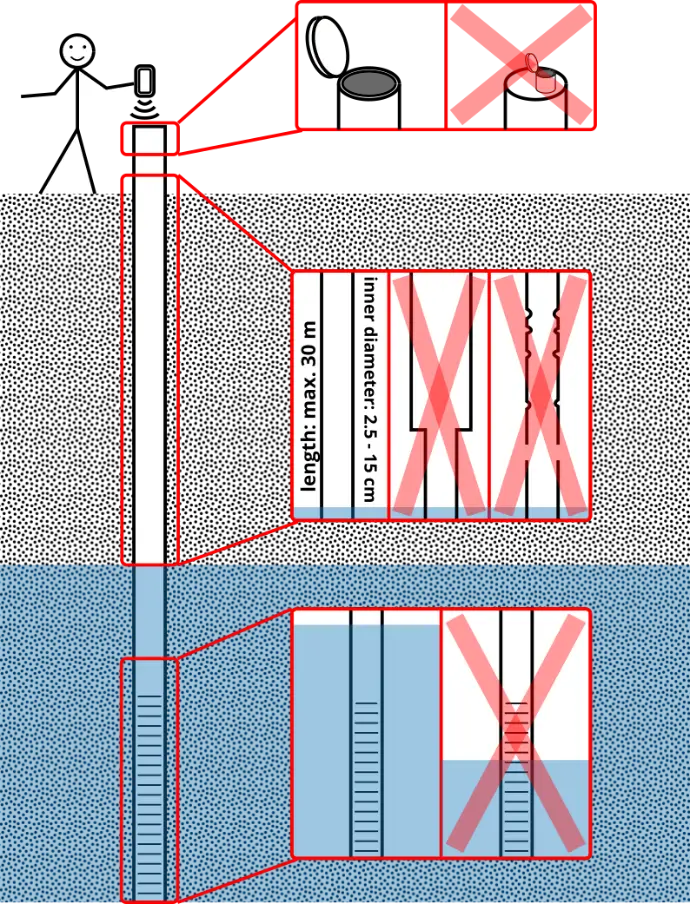
Constant inner diameter
No change in inner diameter and no open screen above the water level.
Changes in the inner diameter and obstacles in the pipe will reduce the quality of the measurements.
Open access at the top
Open access at the top to the full diameter of the pipe.
No "smaller hole for access to a bigger pipe".
Measurement range and maximum depths
The measurement range depends on each tune, as indicated in the Groundwater Global app.
Resonance measurements are designed to work in shallow areas (0.5 - 10 meters deep).
Sonar measurements are designed to work in medium to deep areas (5 - 50+ meters deep).
Filters - perforation bottom pipe
Filters (perforation - small drilled holes) in the bottom of the pipe for the groundwater to move freely in and out of the pipe.
Perforation above groundwater will reduce the quality of the measurements so filters should be submerged.
Tips
Just some of our ideas
Existing monitoring pipes
Where possible make use of already existing monitoring pipes and (hand-dug) wells.
Placement in drilled holes or wells
Pipes can be put in a hole drilled in the ground or they can be mounted in existing (hand-dug) wells.
In hand-dug wells pick a small diameter pipe and mount it on the side so that it does not interfere with water extraction.
Try before you buy
Get a successful measurement with the Groundwater Global app in the pipe before taking the effort of installing the pipe.
Why not try it out in the hardware store - try before you buy!
To try it out the pipe may be held horizontally.
Get the appropriate pipe length
The length of the length pipe is determined by the deepest measurement required.
So make sure that at least a few meters of the pipe are underwater for when the groundwater level drops in the future.
Sustainable pipe material
The material of the pipe may be PVC or metal - or whatever material is available. Make sure it is suitable to put in the ground or into the well.
It is quite a bit of effort to get the pipe installed so make sure that it is sustainable and that the pipe will last a long time.
Don't drop your smartphone
Ideally the pipe diameter is smaller than the width of typical smartphones so that a smartphone cannot be dropped into the monitoring pipe.
That would be a pity!
What does that look like?